
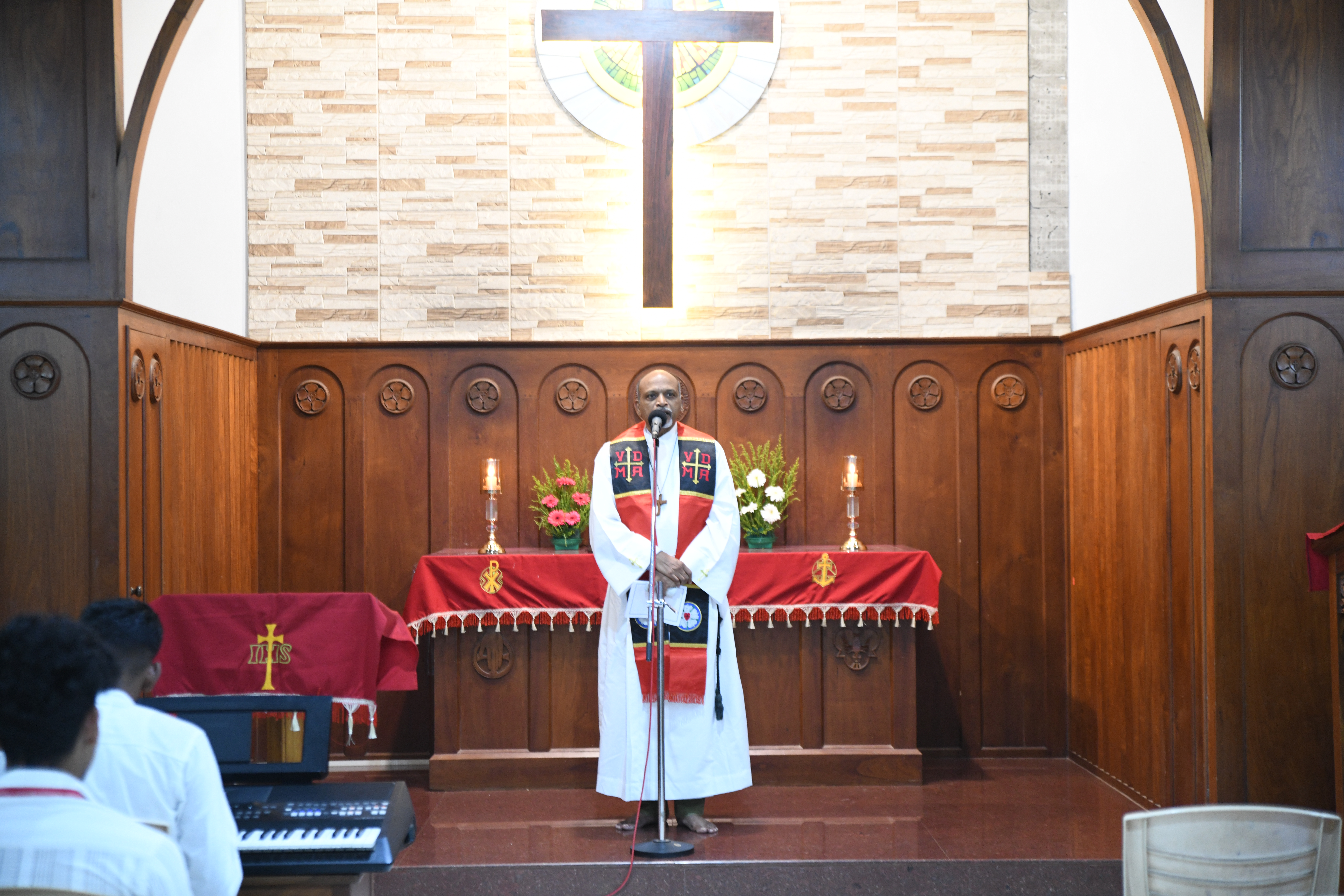
Sermon by Rev. Dr. T. Samuel at the Special Service on the occasion of 102nd Anniversary of CTSN, 8 Sep 2026
Text: 1 Corinthians 3:5–11
Remembering More Than a Date
There are anniversaries that simply count years, and there are anniversaries that measure grace.
Today we do not gather merely to celebrate the longevity of an institution. We gather to remember
the faithfulness of God. A theological seminary is not great because it has survived another year,
accumulated impressive buildings, or produced distinguished graduates. Its true significance lies in
one enduring question: Has it remained faithful to the foundation upon which it was built?
That is precisely the question Paul places before the church in Corinth.
The Corinthians admired gifted leaders. Some preferred Paul’s missionary passion, others Apollos’
eloquence, and still others claimed allegiance to Peter. The church had begun to resemble the
competitive culture of the Roman Empire, where loyalty was offered to influential patrons in
exchange for honor and status. Into that divided community Paul speaks words that remain
startlingly fresh:
“What then is Apollos? What is Paul? Servants through whom you came to believe.”
Notice what Paul does not ask. He does not ask, “Who is greater?” He asks, “What are we?” His
answer is profoundly humbling: servants.
On the anniversary of this seminary, those words invite every principal, professor, pastor, student,
donor, and graduate to rediscover our common identity—not owners of God’s work, but servants
within it.
I. The Seminary Is God’s Field, Not Our Possession
Paul begins with the image of agriculture.
“I planted, Apollos watered, but God gave the growth.”
Anyone who has lived among farmers knows the wisdom hidden in these words. A farmer prepares
the soil, sows the seed, removes weeds, and waits with hope. Yet no farmer can command a seed to
germinate. The mystery of life always remains beyond human control.
The same is true of theological education.
A professor may lecture with brilliance. A mentor may patiently guide a student. A librarian may
preserve priceless treasures of learning. Benefactors may provide scholarships. Administrators may
labour faithfully behind the scenes. Yet none of them can create a vocation. None can manufacture
faith. None can produce a shepherd’s heart.
Only God gives life.
That truth protects the seminary from two dangerous illusions.
The first is the illusion of success. We are tempted to measure ourselves by enrollment numbers,
academic rankings, financial strength, or architectural expansion. These things have their place, but
they are never the measure of God’s kingdom.
The second is the illusion of despair. There are seasons when resources become scarce, faculty
positions remain vacant, buildings require repair, and the future appears uncertain. Paul reminds us
that the growth of God’s kingdom has never depended primarily upon human abundance. The
church was born not in wealth but in the power of the Holy Spirit.
This anniversary therefore becomes an act of gratitude rather than self-congratulation. We celebrate
not what we have accomplished, but what God has graciously sustained.
II. The Seminary Is a Fellowship of Servants, Not a Hierarchy of Importance
Corinth was obsessed with status. Roman society divided people into patrons and clients, rulers and
subjects, elites and laborers. Honor belonged to those who occupied the highest place.
Paul overturns that entire social imagination.
“The one who plants and the one who waters are one.”
The planter is not superior to the one who waters. Different tasks, one calling.
That is a remarkable vision for a seminary community.
Some teach biblical languages. Others teach theology, counseling, worship, or mission. Some
maintain hostels, prepare meals, manage finances, clean classrooms, cultivate gardens, or repair
buildings. Students study diligently. Alumni serve in villages, towns, and cities. Mission partners pray
from distant countries.
Paul refuses to rank these vocations according to prestige. Before God, faithfulness matters more
than visibility.
Martin Luther described ordinary work as vocation—the place where God hides Himself in human
service. God feeds the hungry through the farmer, teaches the church through the professor,
comforts the suffering through the pastor, and nurtures future leaders through countless unseen
hands.
The anniversary of a seminary is therefore never a celebration of famous individuals alone. It is a
remembrance of quiet faithfulness.
We remember the pioneering missionaries who first sowed the seed of theological education in this
land. We honour the teachers whose names appear in old registers and forgotten photographs. We
give thanks for those who translated Scripture, built libraries, shaped curricula, and formed
generations of pastors. We remember students who arrived with little more than faith and left to
serve congregations where no applause awaited them.
Their lives testify to Paul’s words: servants through whom you came to believe.
III. The Foundation Is Jesus Christ Alone
Paul finally leaves the field and enters the construction site.
“You are God’s building.”
Every builder knows that the most important part of a structure is the part no one sees—the
foundation. Beautiful walls cannot compensate for a weak foundation. Towers eventually collapse
when their base is compromised.
Paul speaks with extraordinary clarity:
“No one can lay any foundation other than the one already laid, which is Jesus Christ.”
This is more than a doctrinal statement; it is the very purpose of theological education.
A seminary does not exist merely to produce religious professionals. It exists to form women and
men whose lives are anchored in Christ. Knowledge without Christ becomes arrogance. Ministry
without Christ becomes performance. Worship without Christ becomes ritual. Mission without Christ
becomes ideology.
Christ is not one subject among many in the curriculum. He is the foundation beneath every
discipline.
When students study the Old Testament, they seek the God who fulfills His promises in Christ. When
they study ethics, they learn to embody the compassion of Christ. When they learn pastoral
counseling, they become instruments of Christ’s healing presence. When they preach, they proclaim
not themselves but Jesus Christ crucified and risen.
Every classroom ultimately becomes an extension of the Emmaus road, where Christ opens the
Scriptures and hearts begin to burn within His disciples.
A Prophetic Word for the Church
This text also speaks beyond the seminary walls.
Our world continues to reward personality over character, power over service, competition over
communion. Even churches are tempted to build ministries around celebrity leaders,
denominational pride, institutional influence, or political allegiance.
Paul gently but firmly asks us: What is Paul? What is Apollos?
The question may be rewritten for our own generation:
What is the principal?
What is the professor?
What is the bishop?
What is the pastor?
His answer remains unchanged: servants.
The church loses its witness whenever its leaders seek ownership rather than stewardship. The
gospel flourishes wherever humble servants point beyond themselves to Christ.
For India, where communities still wrestle with caste, inequality, exclusion, and the misuse of power,
this passage offers a radically different vision. At the foot of Christ’s cross there is no higher caste of
disciples, no privileged hierarchy of grace. There are only redeemed sinners called into one body and
entrusted with one mission.
A theological seminary must embody that alternative community before it teaches it.
Conclusion: The Next Century Begins Here
As we celebrate another anniversary, we naturally give thanks for land that was dedicated to God’s
mission, classrooms filled with learning, libraries preserving wisdom, hostels nurturing community,
and graduates serving the church across generations.
Yet the greatest legacy of this seminary has never been its buildings.
Its greatest legacy is every pastor who preached Christ faithfully in a small village church.
Every missionary who carried the gospel across cultural boundaries.
Every counselor who restored a broken family.
Every teacher who formed another generation.
Every student whose heart was quietly transformed by the grace of God.
The story of this seminary is still being written.
The next chapter will not be secured merely by stronger finances or larger infrastructure, important
as those are. It will be secured by women and men who continue to believe that Christ alone is the
foundation, that ministry is humble service, and that all genuine growth comes from God.
Therefore, let us give thanks with confidence.
Let faculty teach faithfully.
Let students study prayerfully.
Let alumni serve courageously.
Let partners give generously.
Let the church pray fervently.
And above all, let this seminary remain what Paul declares the church to be:
God’s field, where lives are cultivated by grace.
God’s building, where Christ alone is the sure foundation.
To read about the 102 year history of Concordia Theological Seminary click here